
You've heard it a hundred times. Post every day. Stay consistent. More content, more growth.
So you try it. You write daily for two weeks, burn through every decent idea you had, and by week three you're posting filler just to keep the streak alive. Meanwhile your reach is quietly sinking. Been there. It's a miserable little spiral.
Here's what nobody says out loud: "post more" is half an answer. The real one depends on your follower count, what you're actually after, and whether you can keep it going for six months without starting to dread it. So let me just give you the number, then we'll adjust it for you.
Short answer: 3 to 5 posts a week for most people. Under 5,000 followers? Start at 2 to 3 and obsess over quality instead. More than one post a day usually backfires. And the honest truth is the frequency you'll actually stick with beats the "ideal" one you quit in a month.
What the data actually says
I didn't pull these numbers out of thin air. A handful of big studies dropped this past year, and the nice surprise is they mostly point the same way.
Buffer went through more than two million posts. Their finding: bumping from one post a week to somewhere in the 2-5 range added around 1,182 impressions per post. So yeah, more helps. On paper. There's a catch, and we'll get there.
Then there's a separate look at 500-plus accounts across 14 industries. Same ballpark, but with a warning worth tattooing somewhere: past 5 posts a week, engagement per post falls 18 to 32 percent. And this one genuinely made me pause. Out of everyone who pushed from 4 posts a week up to 7, only 12 percent actually saw better results.
Twelve percent. So nearly nine in ten people who worked harder, posted more, hustled for that extra content, got nothing. Some got less.
Your follower count changes the answer
Most guides breeze past this, which is wild, because it's the part that actually matters. Someone with 50,000 followers is playing a totally different game than someone with 500 connections. Feed competition, what the audience expects, how distribution even works, none of it is the same.
Rough map for wherever you're standing right now:
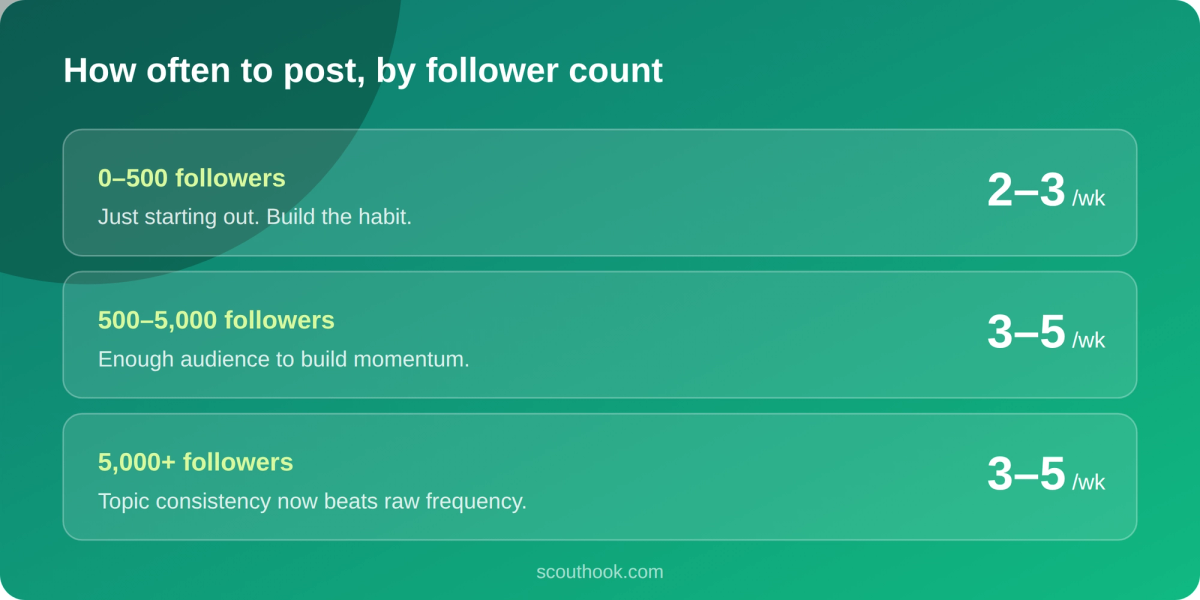
If you have under 500 followers
Two, maybe three a week. Done. You barely have an early-engagement signal at this point, so flooding the feed accomplishes nothing. What helps is getting your writing sharper and just building the habit of showing up. Volume's a later problem.
If you have 500 to 5,000 followers
Now three to five starts paying off. You've got enough audience to throw off those early signals reliably, and that's exactly what the algorithm reads before deciding whether to push you wider. Cadence finally works with you instead of against you.
If you have 5,000+ followers
Still three to five. But here's the twist nobody expects: at this size, what you talk about beats how often you talk. Build a name for one specific thing over a couple months, and the algorithm starts tagging you as an authority on it, which quietly boosts every post you publish, frequency aside. Topic consistency wins. Volume takes a back seat.
Why posting more can actually hurt you
This is the mechanism the "post daily" crowd never bothers explaining. It's called cannibalization. Once it clicks, you'll never double-post again.
When you publish, LinkedIn tests you on a small slice of your network first, maybe 2 to 5 percent. This is the golden hour everyone talks about. It watches how that first group reacts over 60 to 90 minutes. Good reaction, the gates open. Flat reaction, your post quietly dies where it stands.
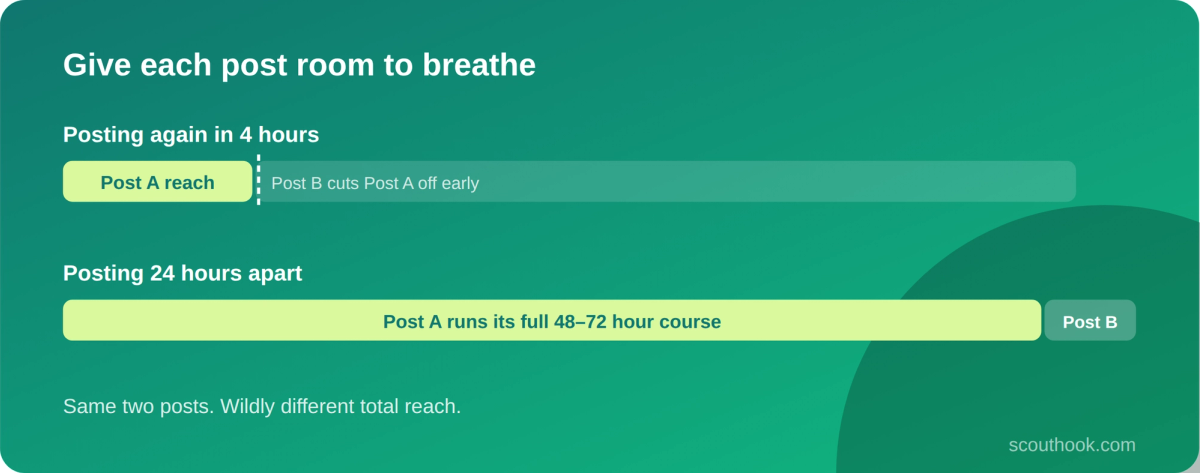
Here's the trap. Post again inside a short window and the algorithm actually chokes off the first post's reach so it can go test the second one. Which is why you want a solid 18 to 24 hours between posts. Think about it: a strong post keeps pulling reach for 48 to 72 hours. Publish too soon and you're cutting off your own best content to hand a new post a worse shot. You're competing with yourself. For free.
The thing that matters more than frequency
Alright, real talk. If you forget everything else here, keep this one. It's not a number at all. It's this: how often you post matters way less than what you do after you hit publish.
The algorithm changed its whole personality. It quit rewarding raw reach and started rewarding depth, or whatever LinkedIn calls "authority" internally these days. Dwell time is king now, not likes. A post someone actually reads for 30 seconds beats one with 50 lazy thumb-taps. It even clocks when people tap in and bounce right back out, then buries that stuff.
And the size of the dwell-time gap is honestly kind of nuts. Posts people scroll past in 0 to 3 seconds pull a 1.2 percent engagement rate. Posts that hold someone for 61 seconds or more? 15.6 percent. That's a 13x swing. No amount of "one extra post a week" comes close to that.
But here's the finding that rewired how I think about all of this. In that 500-account study, the biggest predictor of inbound leads wasn't frequency. Wasn't even close. Accounts posting three times a week while actively engaging beat accounts posting daily with no engagement by 4.2x on leads. Twenty minutes writing plus forty minutes engaging crushed sixty minutes writing plus zero engaging. Not once. Consistently.
So next time you're torn between grinding out a fifth post or spending that hour leaving real comments on other people's stuff and replying to everyone who showed up for you, the data isn't subtle. Go engage. It's not a close call.
When should you actually hit publish?
Timing's the sidekick to frequency, so quick detour. The 2026 studies line up tighter than you'd expect. Tuesday through Thursday, 10am to noon in your audience's timezone. Wednesday's the standout day. That's pulled from four separate studies covering north of eight million posts, so it's not one person's hunch.
One shift most people's schedules haven't caught up to: those late-afternoon and evening hours, 3pm to 8pm, are now beating mornings across the week. So if your mornings are chaos, the afternoon slot isn't the runner-up prize it used to be.
Weekends, though? Engagement nosedives Saturday and Sunday. LinkedIn's a work-hours platform, and something like 70 percent of the activity packs into the weekdays. Not forbidden. Just don't waste your best post there.
A schedule you can actually keep
Let me pull you back from the burnout cliff, because that's what actually sinks most people's LinkedIn run. Not the wrong number. The grind.
Do not try to carve out 30 minutes every single morning to write something great under a ticking clock. That plan dies in three weeks, guaranteed. Batch instead. Knock out three posts in one focused Sunday sitting, schedule them for Tuesday, Wednesday, Thursday, and suddenly you're protecting one hour a week to hold a three-post rhythm basically forever.
Batching pulls double duty. It keeps you consistent when a week goes sideways, and it just makes the writing better, because you're in a flow state instead of panic-typing. The best posting frequency, when you strip it all down, is the one you can hold with real quality for six months without it turning into a chore.
Which is honestly the whole reason ScoutHook exists, a content tool built to make batching actually doable: catch ideas the second they hit, spin one idea into several posts, keep a queue humming so "three a week" happens for real instead of staying a nice thought. And if you're staring at a blank screen during those batch sessions, our list of 27 LinkedIn post ideas and our guide to writing hooks that stop the scroll will keep the well full.
So, what's your number?
Let's land this. Not sure where to start? Three a week. Feeling good and keeping quality high? Push to five. Life exploding? Drop to two, because two a week for a year buries daily-for-a-month-then-silence every time.
Space them a day apart minimum. Aim Tuesday to Thursday. Put as much time into engaging as writing. And treat every post like it has to earn 30 real seconds of attention, not a reflex like.
Pull that off and the exact number basically stops mattering. You'll be in the range that works, doing the thing that actually drives results, on a schedule you won't ditch by February. That's the whole game.
Frequently asked questions
How often should you post on LinkedIn?
For most people, 3 to 5 times a week. Under 5,000 followers, start at 2 to 3 and put quality first.
Is it bad to post every day?
Only if quality slips. Daily can work when every post is genuinely different, but past 5 a week engagement per post usually drops, and two in one day can cut the first one's reach.
How many times a week should a beginner post?
Two to three. Early on, the habit and your content quality matter way more than volume.
What's the best time to post?
Tuesday through Thursday, Wednesday being the strongest single day. Late afternoons, 3 to 8pm, are surprisingly strong now too. Weekends are weak.