
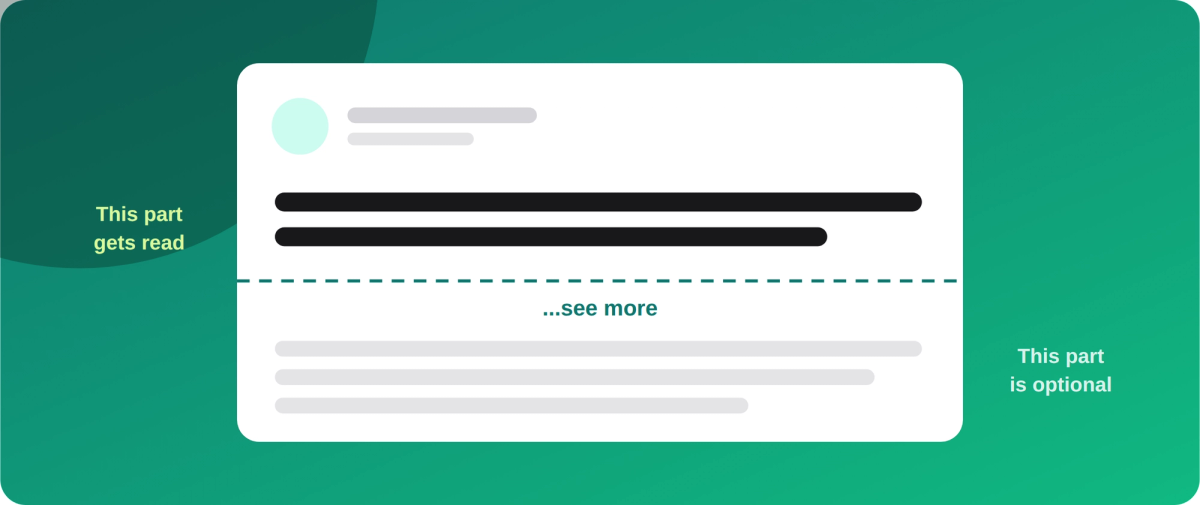
Here's an uncomfortable stat about your LinkedIn posts: most people who see them read exactly two lines. That's what fits before the "...see more" fold. Two lines. Maybe 210 characters if you're lucky.
If those two lines don't do their job, nothing else you wrote matters. The story, the insight, the clever ending you spent twenty minutes on. Nobody sees it.
I learned this the annoying way. I once wrote a post I was genuinely proud of, a real story with a real lesson, and it got 4 likes. Two were coworkers. One was my aunt. A month later I reposted the exact same story with a different first line and it did 40x better. Same post. Different hook.
So let's talk about that first line.
What a hook a__ctually has to do
One job. Make someone stop scrolling long enough to click "see more."
That's it. The hook doesn't need to summarize your post. It doesn't need to be clever. It definitely doesn't need to be professional-sounding, whatever that means. It needs to create a gap between what the reader knows and what they suddenly want to know.
Curiosity gap. That's the whole mechanism. Everything below is just fifteen different ways to build one.
15 hook formats that keep working
1. The confession. Admit something people in your position usually hide.
"I've been a marketing manager for 6 years and I still Google 'what is a good CTR' before every report."
2. The number that doesn't make sense. Lead with a stat or result that needs explaining. The gap between the number and the explanation is your hook.
"We deleted 40% of our website and traffic went up."
3. The unpopular opinion, stated flatly. No hedging. Hedging kills hooks.
"Cold outreach isn't dead. Your messages are just boring."
4. The mid-story start. Skip the setup. Drop the reader into the worst moment.
"The client hung up on me. Then he emailed my boss."
5. The "everyone vs. me" split.
"Everyone told me to niche down. I did the opposite and doubled my revenue."
6. The direct callout. Name your exact reader in the first line. Works because people can't not react to their own description.
"If you're a founder posting on LinkedIn and getting 3 likes per post, read this."
7. The time stamp. Specific dates and timeframes read as true. Vague reads as fake.
"On March 4th, 2023, I got fired. On March 4th, 2026, I signed my biggest client. Same date, wild coincidence, real story."
8. The question you actually can't answer instantly. Not "have you ever struggled with productivity?" Everyone scrolls past that. Something with teeth.
"Would you take a 20% pay cut to never attend another meeting? I asked 50 people. The answers surprised me."
9. The mistake list opener.
"I've made every hiring mistake you can make. Here are the 5 that cost me the most."
10. The two-word punch. A tiny first line followed by a longer second one. The rhythm itself stops the scroll.
"I quit. Not the job. The way I was doing the job."
11. The eavesdrop. Open with something someone said to you. Dialogue pulls people in faster than description. It always has.
"'You're too expensive.' I hear this every week. Here's what I say back."
12. The before/after in one line.
"18 months ago I couldn't get a reply. Yesterday I turned down a client."
13. The myth flip. Take advice everyone accepts and reverse it.
"'Post consistently' is the most misunderstood advice on this platform."
14. The receipt. Promise proof, not opinion.
"Here's the exact email that landed us a $30k project. Copy the structure, not the words."
15. The honest struggle. Present tense. Unresolved. These outperform victory posts more often than people expect, because feeds are full of wins and empty of middles.
"Month 7 of building this company. Still not sure it's going to work. Here's where we actually are."
The three ways hooks die
They start with a warm-up. "I've been thinking a lot lately about..." Nobody needs your throat-clearing. Delete the first sentence you wrote. The real hook is usually your second sentence anyway. This one edit improves more posts than any other trick I know.
They give everything away. "5 tips for better sales calls: preparation, listening, follow-up, empathy, and timing." Cool, you just told me everything. Why would I click see more? Tease the list. Don't unpack it.
They try to sound smart. Big words, formal tone, passive voice. LinkedIn is a feed, not a journal. Write the hook like you'd say it to a friend across a table. If you wouldn't say "I am pleased to share" out loud, don't type it.
A simple workflow that helps
Write the whole post first. Ignore the hook completely.
Then write five different hooks for it. Not one. Five. The first hook you write is almost always the most obvious one, and obvious doesn't stop scrolls. Hooks three, four, and five are where it gets interesting, because that's when you run out of easy options and start actually thinking.
Pick the one that would make you stop. Not the one that sounds most polished. The one that itches.
And save the four you didn't use. Seriously. A rejected hook is often a whole future post waiting to happen. Keep them in a note, a doc, or a content tool like ScoutHook, which was built around exactly this idea: one thought, several posts. If you need raw material to practice on, we also put together 27 LinkedIn post ideas you can pair with these hook formats.
Last thing
Don't overthink this into paralysis. A decent hook on a published post beats a perfect hook on a draft, every single time.
Pick three formats from the list that feel natural to you. Use them for two weeks. Watch which one your audience responds to. Then keep that one and swap the others out.
Two lines. That's all you're fighting for. Make them count.