
Some numbers to ruin your morning. Organic reach on LinkedIn dropped roughly 50% in 2026. Engagement fell 25%. Follower growth crashed by 59%. That's from Richard van der Blom's algorithm report, and it's the clearest signal yet that whatever you were doing in 2024 is now producing about half of what it used to.
Here's the part that surprised me though. Creators who adapted are doing better than ever. Not the same. Better. Because when the floor drops out from under generic content, the people with something real to say suddenly have less competition.
Which means the gap between "posting on LinkedIn" and "having a LinkedIn strategy" just became enormous. This is the strategy. Four parts, and honestly none of them are complicated. They're just things almost nobody does.
The gist: Write one sentence about who you're for. Pick three topics you'll own. Set a cadence you can hold for six months. Spend as much time in other people's comments as you do writing. That's the whole strategy. Everything below is just detail.
Why most "strategies" are just vibes
Ask ten people about their LinkedIn strategy and nine will describe a habit. "I post when I have something to say." "I try to do twice a week." That's not a strategy, that's a mood.
A strategy answers four questions, and if you can't answer all four right now, that's the actual problem, not your writing:
Who is this for? Not "professionals." Someone specific enough that you could name three of them.
What am I known for? Three topics. If you name six, you're known for nothing.
How often, forever? Not this month. Forever. The number you'd still hit in a bad week.
What happens after I post? Ninety percent of people have no answer here, and it's the part that decides everything.
Random posting used to work anyway, because reach was cheap. It isn't anymore. 70% of B2B buyers research vendors on LinkedIn before ever reaching out, so the audience is absolutely there. They're just not going to find you by accident now.
Step one: the one sentence
Before pillars, before cadence, before any of it. Write this sentence down:
"I write for [specific people] who are struggling with [specific problem]."
Vague version: "I create content for professionals interested in growth." Useless. Filters nothing.
Instead of "I post about marketing for business owners" → "I write for B2B SaaS founders at Series A who can't build pipeline beyond paid ads."
The second one is a machine. Every idea you have goes through it: would this matter to a Series A founder with a pipeline problem? No? Then it's not a post, it's a thought you had. Let it go.
This single sentence kills more bad posts than any editing process, and it takes four minutes to write. Do it before you read further, honestly.
Step two: three pillars, not eight
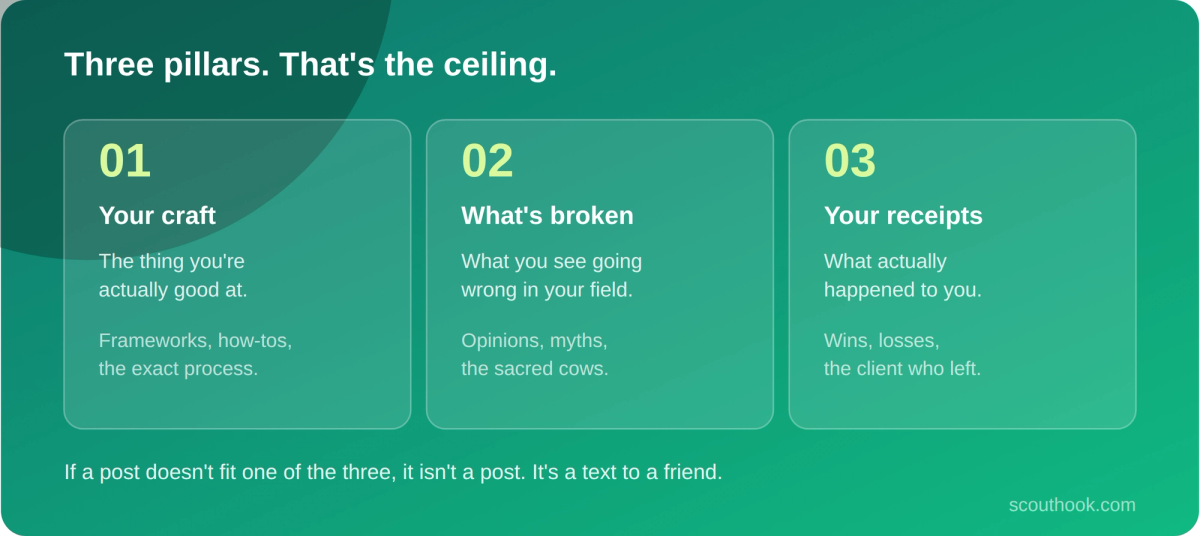
Content pillars are the recurring topics you'll return to over and over. They sit where your expertise overlaps your audience's problems.
Every serious analysis lands on the same number: three pillars is optimal, because more causes inconsistency and audience confusion. One gets boring. Eight makes you invisible.
And there's a mechanical reason, not just an aesthetic one. The algorithm has to categorize you to know who to distribute you to. Stay narrow and it learns to push your posts to people who care about that thing, even strangers outside your network. Scatter yourself and it can't figure out your audience, so it picks nobody.
Filling them without going insane
Here's the move that saves you: under each pillar, write down 15 to 20 specific topics. Not "leadership." More like "why our best hire had no relevant experience."
Do it once. Sit down for forty minutes and just dump. Now you've got 45-60 posts banked, which at three a week is roughly five months of content. The blank-screen problem, permanently solved, because you're never inventing under pressure again, just picking from a list you made when you were thinking clearly.
Step three: a cadence you'll still hit in November
Everyone overestimates this. Then they burn out in week three and disappear, which is worse than never starting because now the algorithm has to re-learn you.
The data says three to five posts a week for most people, and that beyond five, engagement per post actually drops. But here's the thing that matters more than the number: a founder who posts three times a week every week builds more algorithmic authority than one who posts daily for two weeks then disappears for a month.
So pick the number you'd hit during a bad month. Not a good one. If three feels doable, do two. Seriously. You can always add.
And batch it. One Sunday session, three posts, scheduled. That's one protected hour a week instead of five stressful mornings, and the writing comes out better because you're in a flow instead of panicking before a meeting.
Step four: the formats, roughly ranked
Not all formats are equal, and the gaps are bigger than you'd expect.
Document carousels. Still the top organic format, because every swipe is a measurable interaction and they hold attention longer than anything else. Six to ten slides.
Story posts. Text, personal, specific. Story-driven posts get roughly 5x more comments than generic advice, because a real situation is harder to scroll past than a listicle. Underrated because they look too simple to work.
Native video. Under 90 seconds. A founder opinion or a walkthrough. Works, but it's a bigger production lift than the return usually justifies unless you're comfortable on camera.
Single images. Oddly, these now underperform plain text. If you're adding a stock photo to a good post, you're making it worse.
Polls. Spike reach, tank everything else. Fine for occasional research, terrible as a strategy.
One structural thing worth knowing if you're a founder: your personal profile beats your company page by a mile. Personal profiles pull 238% more comments per post, and text posts on a personal profile get 2.86x the impressions of the same thing on a company page. Build yours first, the company page can wait.
What a week actually looks like
Enough theory. Here's a rhythm that works and doesn't require heroics.
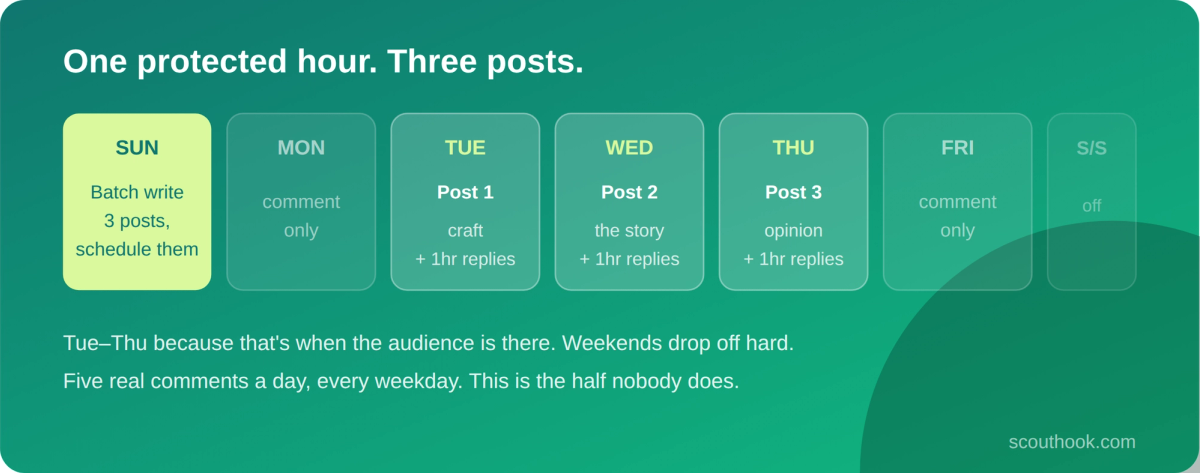
Notice what's missing: heroics. There's no 5am writing sprint. One planning session, three posts, and a daily habit of showing up in other people's comments.
The half of the strategy nobody runs
This is where I'd push hardest if we were talking in person.
Writing is the visible half. Commenting is the half that works. And the data on this is not close: accounts posting three times a week with active engagement beat accounts posting daily without it by 4.2x on lead generation. Same platform. Less writing. Four times the pipeline.
The mechanics are almost unfair. Your headline travels with every comment you leave, so a good comment on a post with 400 readers puts your name and positioning in front of 400 people for about ninety seconds of work. Do that five times a day and you've out-reached your own posts without writing a word.
It also feeds your own distribution, since commenting in your niche reinforces the topical signal that tells the algorithm what you're about. And "Great post!" doesn't count. The system reads that as noise, because it is. Add a point, disagree politely, tell the specific thing that happened to you.
The rule: if you have an hour, spend twenty minutes writing and forty commenting. It feels backwards. It isn't.
How to tell if it's working
Stop watching likes. Genuinely. They're the weakest signal in the system now and they'll tell you nothing useful.
Watch these instead:
Comments per post. The heaviest signal, worth roughly fifteen likes each. If a post pulls real conversation, it worked, regardless of the like count.
Saves. Someone bookmarking your post is the strongest quality vote there is, and almost nobody optimizes for it. Frameworks and checklists get saved. Motivational quotes don't.
Profile views. The bridge between content and opportunity. Rising views means people are curious enough to check you out, which is the whole point.
DMs and inbound. The only metric that pays rent.
Once a month, pull your top five posts and look for the pattern. Format, topic, hook style, length. Most accounts find two or three pillars that consistently outperform everything else. Then do more of that and quietly retire the rest. That's the whole optimization loop, and it takes twenty minutes.
The 90-day reality check
Let's set expectations properly, because this is where most strategies die.
Sixty to ninety days before you see measurable movement. Around six months for results to genuinely compound. That's not pessimism, it's just how it works: the algorithm needs time to categorize your expertise, and humans need repeated exposure before your name means anything.
Month one will feel pointless. Month two you'll want to quit. Month three something starts happening. That's the standard curve and nobody talks about it because "post for 90 days and feel nothing" is a bad hook.
Which brings me to the only real advice in this entire piece: design for month nine, not week two. Pick a cadence you'd still hit when work explodes. Pick topics you won't get bored of. Because the people who win at this aren't better writers than you. LinkedIn members who post consistently see roughly 3x more leads than those who don't, and consistency is a design problem, not a willpower problem.
A strategy you'll still be running in month nine. ScoutHook understands the expertise behind your ideas and asks the right questions to draw it out, then keeps you planned and consistent on the topics you actually own. Try ScoutHook → https://www.scouthook.com
Your first hour
If you do nothing else from this, do this hour:
Minutes 1-5: Write your one sentence. Who, and what problem.
Minutes 5-15: Name your three pillars. Craft, what's broken, your receipts. Or your own version.
Minutes 15-55: Dump 15 topics under each. Don't filter, just write.
Minute 55-60: Pick three from the list. Schedule them for Tuesday, Wednesday, Thursday.
That's a strategy. Not a course, not a framework with a trademark, not a growth hack. One sentence, three pillars, a cadence, and the discipline to show up in other people's comments. The rest is just doing it for longer than everyone else has the patience for.
Frequently asked questions
What is a LinkedIn content strategy?
Four things: a sentence naming who you're for, three topics you own, a cadence you can hold for months, and a habit of engaging in other people's comments. Without those, posting is guessing in public.
How many content pillars should I have?
Three. One is repetitive, more than four makes you unrecognizable to both people and the algorithm.
How long until it works?
60 to 90 days for measurable movement, around six months to compound. Month two is when everyone quits.
Is it too late to start in 2026?
No, but the bar moved. Reach fell about 50% and generic content is penalized, so posting without a strategy produces roughly nothing. The flip side is that genuine expertise is rewarded more than it's ever been.
How many posts per week?
Three to five for most people. Pick the number you'd still hit in a bad week, not a good one.