
The phrase "personal brand" makes most normal people wince a little. Fair. It calls to mind guys in rented Lamborghinis and posts that open with "Let that sink in." Nobody wants to be that.
But here's the awkward truth. You already have one. Every time someone reads your comment, gets your connection request, or hears your name in a meeting, they form an impression. The only question is whether that impression is deliberate or accidental. That's it. That's the whole concept, stripped of the nonsense.
So this is a guide to doing it on purpose, without becoming insufferable. Real data, specific steps, and a few opinions.
The gist: A personal brand is just being known for one specific thing by the right people. Fix your profile first (it's a landing page, not a résumé), pick two or three topics and stay in that lane, post a few times a week, and spend as much time in the comments as you do writing. Give it 90 days before you judge it.
What it actually is, minus the fluff
Strip away everything and a personal brand is one sentence: what you're known for, by whom.
Not your logo. Not your color palette. Not a curated persona. Just whether a specific group of people, the ones who could hire you, buy from you, or refer you, think of you when a specific problem comes up.
Which means "personal branding" is mostly just being specific in public, repeatedly, about something you actually know. The reason it gets a bad name is that a loud minority does it by performing expertise they don't have. That's not branding. That's cosplay, and people can smell it.
Here's my slightly unpopular take: the cringe posts you hate aren't cringe because they're personal branding. They're cringe because they're generic. "Hustle harder" is cringe. "Here's the exact pricing mistake that cost me a client last month" is just useful. Same platform, same intent, totally different reaction.
Okay, but why bother
Because the numbers are ridiculous, honestly.
44% of employers have hired someone because of their personal brand, and 54% have rejected candidates because of a poor online presence. Read that second one again. More than half. Your profile is doing work for you or against you right now, while you're reading this.
And on the upside: professionals with active personal brands receive 47% more inbound opportunities than those with dormant profiles. Nearly double. Just from showing up.
There's also a structural thing worth knowing. LinkedIn trusts people more than logos. Personal profiles generate 238% more comments per post than company pages, and text posts on personal profiles get 2.86x more impressions than the same thing on a company page. If you're a founder wondering whether to build the company page or your own profile, the data isn't subtle. Build yours. The company page can wait.
But the real reason? The bar is embarrassingly low. Most profiles are incomplete, bland, and dormant. Doing the basics well puts you ahead of the majority, which is a strange thing to be able to say about anything competitive.
Your profile is a landing page, not a résumé
This is the mental shift that fixes everything else.
A résumé lists what you did. A landing page answers one question for a visitor: is this person worth my time? And you have about six seconds to answer it, because that's roughly how long people look before deciding.
Every post you write sends people here. So a great post plus a confusing profile equals a wasted post. Fix this first.
The photo (do this one today)
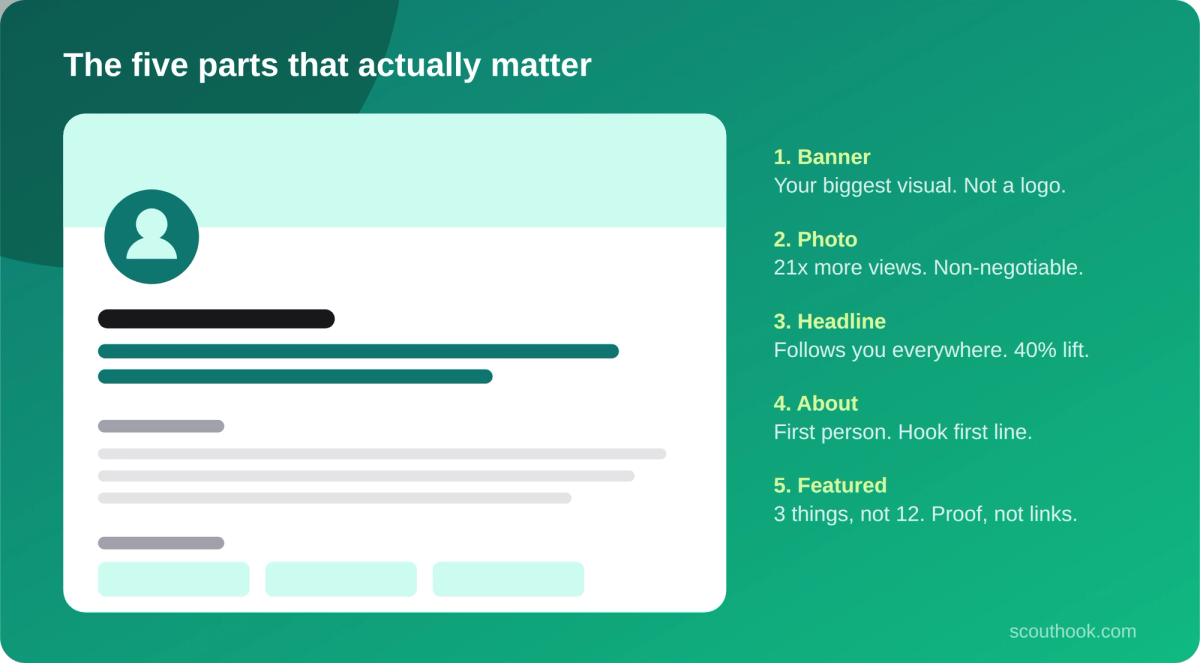
If you fix exactly one thing, fix this. LinkedIn's data shows profiles with photos get 21 times more views and 36 times more messages. Twenty-one times. Nothing else you change comes close.
It doesn't need a photographer. Good natural light, plain background, face filling most of the frame, and you looking like a person rather than a hostage. Phone camera is fine. Take twenty, pick one, move on.
The headline (the highest-leverage line you own)
Your headline follows you everywhere on LinkedIn. Search results. Comment sections. Message previews. Every post you write. It's the most-read line you'll ever publish, and most people waste it on their job title.
Profiles with optimized headlines receive 40% more profile views. The fix takes five minutes: instead of your title, say what you do, who you help, and what they get.
Instead of "Marketing Manager at ABC Company" → "Helping SaaS startups build B2B pipeline through content that actually converts"
Instead of "CEO | Entrepreneur | Visionary" → "I help agency owners fix their pricing so they stop working for free"
One of those gets forgotten instantly. The other makes someone click. You've got 220 characters, use them on your reader, not your ego.
The banner (the most wasted space on LinkedIn)
It's the largest visual element on your profile and roughly everyone leaves the default blue gradient sitting there. Free real estate. Put your value proposition on it, or a key stat, or a photo of you actually doing the work. Just don't use your company logo alone, because most visitors won't recognize it and it tells them nothing.
The About section (write like a human, not a press release)
First person. Always. "Sarah is a results-driven professional" reads like an obituary. "I spent six years watching good agencies undercharge, so now I help them fix it" reads like a person.
Open with a hook, same as a post, because LinkedIn truncates this section and only the first couple of lines show before someone has to click "see more." Then: who you help, how, and some proof. Keep it short. Nobody's reading 600 words about your journey.
Featured and Skills (the two-minute wins)
Featured: pin three to five things, your best post, a case study, a lead magnet. Not twelve. Three strong pieces beat twelve mediocre ones, and a cluttered Featured section just makes people bounce.
Skills: this one's a freebie. List at least five skills and recruiters are 27 times more likely to find your profile. Twenty-seven times, for a task that takes ninety seconds. Just do it.
Pick a lane and stay in it
Here's where most people quietly sabotage themselves. They post about leadership on Monday, a conference photo Wednesday, some industry news Friday, a personal reflection Sunday. Feels varied. Actually it's just noise.
The algorithm needs to categorize you. Post consistently about one narrow topic and it learns to push your content to people interested in that topic, even strangers outside your network. Scatter yourself across ten topics and it can't figure out who to show you to, so it shows you to almost nobody. We broke down exactly how this machinery works in our guide to the LinkedIn algorithm.
But forget the algorithm for a second, because humans work the same way. You don't remember the person who posts about everything. You remember "the pricing guy" or "the woman who does those teardowns of bad landing pages." Specific beats broad, in machines and in memory.
Practical version: pick two or three themes. Not one, that gets boring. Not eight, that's noise. Something like: your craft (the thing you're actually good at), your industry's problems (what you see going wrong), and your process (how you actually work). Everything you post should fit one of those three buckets. If it doesn't fit, it's a text to a friend, not a post.
And if you need to shift your topics later, do it gradually over months. People who abruptly pivoted their whole content lane got, memorably, deprioritized out of existence.
What to actually post
Now the fun part. And the good news is you don't need to be clever, you need to be specific.
One data point that surprised me: multi-image posts have the highest engagement rate of any format on personal profiles at 3.71%, well above carousels at 1.44%, single images at 1.81%, and video at 1.80%. Meanwhile plain text posts on personal profiles quietly outperform anything a company page puts out. So if you've been avoiding text-only posts because they feel too plain, that's the gap to close. A 200-word observation about something you noticed at work this week will beat a carefully designed graphic more often than you'd expect.
Content that builds a brand, in rough order of how well it works:
Things that went wrong. The client you lost, the launch that flopped, the assumption that was dead wrong. Nothing builds trust like admitting something out loud that everyone else is hiding.
Opinions with a spine. Not "engagement bait" opinions. Real ones you'd defend at a dinner table. If nobody could disagree with your post, it wasn't an opinion, it was weather.
Your actual process. How you price. How you scope. The exact steps. People are starved for specifics because everyone else is publishing abstractions.
Small, unglamorous observations. Something a client said. A pattern you noticed across three projects. These do way better than milestone announcements, which nobody but your mom cares about.
What doesn't build a brand: motivational quotes, humblebrag milestones, engagement bait, and anything that could have been posted by any of ten thousand other people in your industry. If your name were removed and nobody could tell it was yours, it wasn't a brand post. It was filler.
Stuck on what to write? Our list of 27 LinkedIn post ideas covers the formats that work, and since your first two lines decide whether anyone reads the rest, our guide on writing hooks pairs well with it.
The part everyone skips
Writing posts is the visible half. The invisible half is where brands actually get built, and almost nobody does it.
Comments. Yours, on other people's posts.
Here's why it works mechanically: your headline rides along with every comment you leave. Leave a genuinely good comment on a post with 400 people reading it, and 400 people just saw your name and your positioning. That's a post's worth of visibility for ninety seconds of work.
There's an algorithmic angle too. Commenting inside your niche reinforces your topical signal, which strengthens your own distribution. And engagement is early-window sensitive: posts that pull a few real commenters in the first hour get pushed substantially wider, which is exactly why replying fast to your own comments matters so much.
The rough rule most people who do this well follow: spend as much time engaging as writing. If you've got an hour, that's twenty minutes writing and forty minutes in other people's comment sections. It feels backwards. It works better.
And "Great post!" doesn't count. That's noise, and the system reads it as noise. Add a point. Disagree politely. Share the specific thing that happened to you. Three sentences that make the original poster want to reply.
How long this actually takes
Let's be honest about the timeline, because unrealistic expectations kill more personal brands than bad content ever will.
Roughly 60 to 90 days of consistent posting before you see measurable movement. Six to twelve months before you've got the kind of recognition that produces steady inbound. That's not a scam, that's just how both the algorithm and human memory work: the system needs time to categorize your expertise, and people need repeated exposure before your name sticks.
Which means the only real failure mode is stopping. Someone posting twice a week for a year will comprehensively beat someone posting daily for three weeks and then vanishing. Every time. The whole game is designing a pace you won't quit, which is exactly why we mapped out the actual data on how often to post.
My honest advice: pick a cadence that feels almost too easy. Two posts a week, batched on a Sunday. If you're still enjoying it after two months, add a third. The people who win here aren't the most talented writers. They're the ones who were still around in month nine.
Stay in your lane, without the grind. ScoutHook helps you capture ideas, keep your posts on-topic, and batch a week's worth in one sitting, so consistency stops depending on motivation. Try ScoutHook → https://www.scouthook.com
Where to start this week
If this feels like a lot, ignore most of it. Do these four things:
Today: add a real photo and rewrite your headline to say who you help. Fifteen minutes, and it's the highest-return fifteen minutes on this whole list.
This week: pick your two or three topics. Write them down somewhere you'll see them.
Next week: post twice. About your topics. Nothing clever, just specific.
Every week after: keep posting twice, and leave five real comments on other people's posts.
That's the entire strategy. No personal branding course required, no rented Lamborghini. Just being specific in public about something you actually know, for longer than everyone else has the patience for.
Frequently asked questions
What is personal branding on LinkedIn?
Being known for one specific thing by the right people. It comes down to a clear profile, consistent posting on a narrow topic, and real engagement. It's not self-promotion or a curated persona.
How do I start?
Profile first: photo, headline, About section. Then pick two or three topics and post about them twice a week. Then start commenting on other people's posts in your space.
How long does it take?
60 to 90 days for measurable movement, 6 to 12 months for steady inbound. The only real failure is quitting before then.
Does the profile photo really matter that much?
Yes. Roughly 21x more profile views and 36x more messages with one. It's the single highest-return change available to you.
Personal profile or company page?
Personal, especially early. Personal profiles pull 238% more comments per post and 2.86x the impressions on text posts. People talk to people.