
Scroll your feed for two minutes and count how many posts you could swap the names on without anyone noticing.
Most of them. They're competent. They're formatted well. Three-line paragraphs, a tidy list, a question at the end. And they all read like they came off the same assembly line, because in a sense they did.
Here's the thing though. That's not a complaint, it's an opportunity, and a bigger one than most people realize. When everything sounds the same, sounding like yourself stops being a nice-to-have and becomes the entire competitive advantage.
The gist: Voice isn't personality or style. It's the specific things only you know, said the way you'd actually say them. Generic posts don't get penalized, they just don't get read, and that's what kills their reach. The fix is one question: what do I know from doing this that isn't sitting in a hundred other posts already?
The sludge problem
There's a term for what happened to the feed and it's unkind but accurate. The cost of producing words collapsed, but quality didn't rise. The result is a content sludge problem: too much sameness, too much recycled advice, too much text that sounds fine but says little.
Supply went near-infinite. Standards didn't move. So the feed filled up with posts that are technically fine and completely forgettable.
And LinkedIn noticed. The platform now behaves more like a proof system than a social feed. It rewards content that shows real skill and real work, and reduces the reach of content that aims for wide appeal but lacks depth. Analysts have started calling it a lived-experience filter, which is a slightly grand name for a simple idea: prove you actually did the thing.
There's a related finding I find quietly funny. LinkedIn's own CEO has pointed out that the barrier to posting on LinkedIn is much higher than on other platforms, because the professional stakes are real. Get called out on X and it's Tuesday. Get called out on LinkedIn and your future employer is reading it. That pressure is exactly why hollow content performs so badly here and does fine elsewhere.
The algorithm isn't punishing you. It's worse than that.
This is the part that reframed the whole thing for me, so stay with it.
Everyone assumes there's a detector. That LinkedIn scans your post, decides it's generic, and throttles it. That's not what happens. LinkedIn's algorithm cannot detect machine-written content. What it detects is whether anyone cared enough to finish reading.
Read that again, because the implication is significant. There's no penalty. There's no flag. What actually happens is:
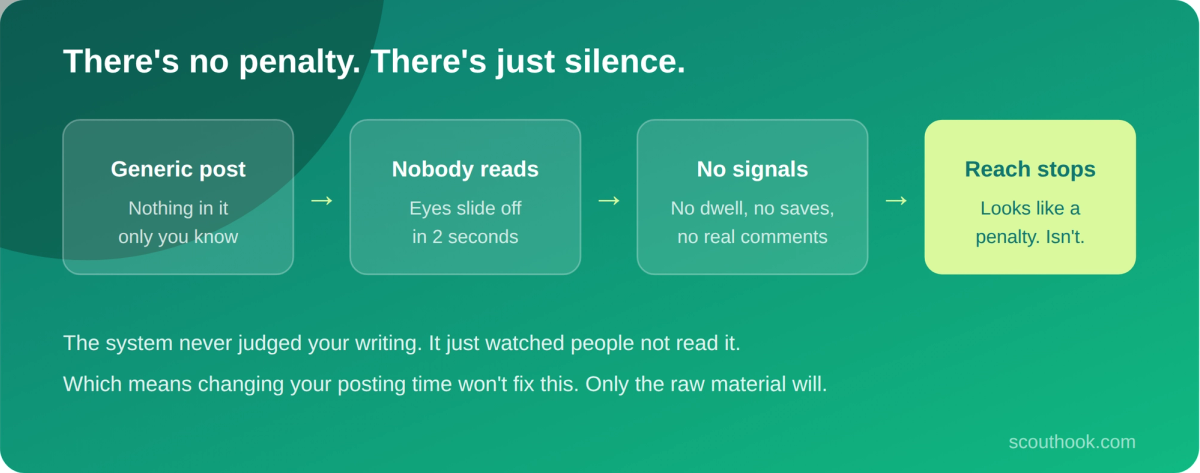
Generic content produces near-zero dwell time, earns no saves, and triggers no real discussion. The system reads that behavioral silence and stops distributing. It looks like a penalty. The mechanism is just that nobody actually read it.
And this explains something that frustrates a lot of people. You change your posting time. You try a new format. You add a hook you found in a swipe file. Nothing moves. Of course nothing moves, because none of those touch the actual problem, which is that the post has nothing in it worth stopping for. We covered how the distribution machinery works in our breakdown of the LinkedIn algorithm, but the summary is: format is downstream of substance.
What voice actually means
Voice gets talked about like it's a style thing. It isn't. You don't need to be funny, or a good writer, or to have a "brand tone."
Voice is the specific things only you know, said the way you'd actually say them. That's it. Two parts, and the first one matters more.
It can't be copied because nobody else sat through your Tuesdays. Nobody else lost that client, noticed that pattern across three projects, or had that manager who said the thing you still think about. That's not a personality trait you're born with. It's just inventory, and you've been accumulating it your whole career without filing it anywhere.
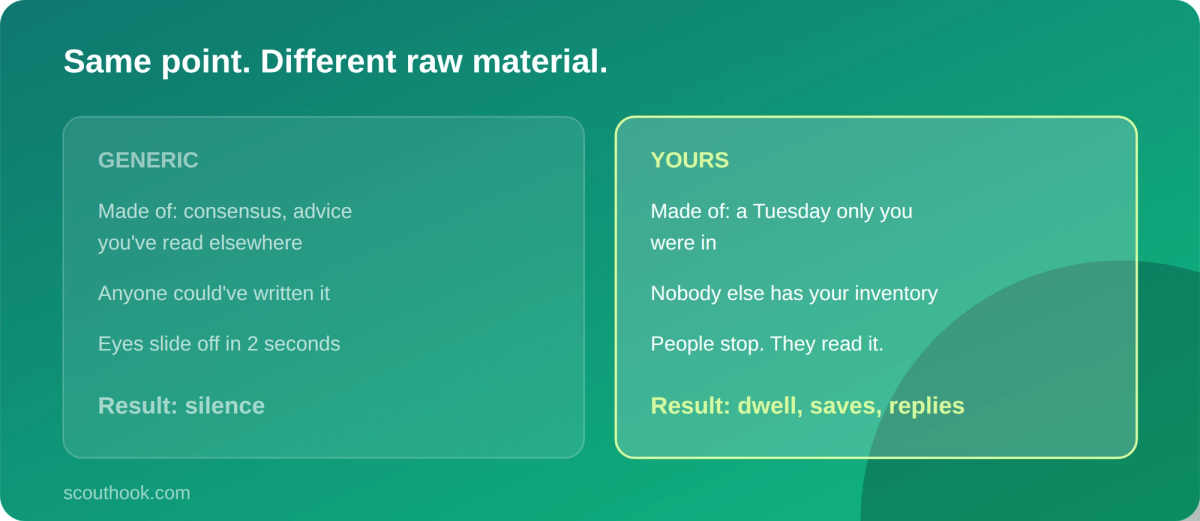
Here's the same idea in two versions:
Generic: "Building trust with clients is essential for long-term success. Focus on transparency and communication."
Yours: "A client told me 'I don't pay you to agree with me' six years ago and it still rearranges how I run every kickoff call."
Same underlying point. One is true of everyone and useful to no one. The other happened to a specific person on a specific bad afternoon, and you can't find it in another post because it isn't in one.
The one question that fixes most posts
Forget "be authentic," it's useless advice because nobody knows what to do with it on a Tuesday morning.
Here's the actual brief, and I think it's the most useful sentence in this whole piece: find one thing you specifically know from direct professional experience that is not available anywhere else in exactly this form. Build the post around that.
That's a test you can run in ten seconds. Look at your draft and ask: could someone else in my industry have written this?
If yes, you don't have a post. You have a summary of the general consensus, which is worth nothing because it's already everywhere.
If no, if there's a number only you have, a moment only you were in, a pattern only you noticed, then you have something. Everything else in this article is just packaging around that.
Six things that make writing sound like a person
Assuming you've got real raw material, here's how not to sand it into nothing on the way out.
1. Specifics, always
"A client" is fine. "A client who ran a plumbing supply business out of a garage in Sacramento" is a post. Numbers, names of places, days of the week, dollar amounts. The specific detail is what makes it feel witnessed rather than assembled, and it's the single fastest upgrade available to any draft.
2. Admit something
The stuff you'd normally edit out is usually the stuff that lands. The part where you handled it badly. The thing you got wrong for three years. Testing consistently shows raw, honest posts outperform carefully edited ones in both reach and meaningful engagement. Not because vulnerability is a hack, but because nobody's pretending, and you can feel that.
3. Uneven rhythm
Read your post out loud. If every sentence is roughly the same length, it'll read like a machine even if a person wrote it. Real speech is lumpy. Short one. Then a longer one that winds through a thought and takes its time getting where it's going. Then a fragment. That unevenness is a signal all by itself.
4. Actual opinions
Not "some argue that." You. What do you think? Consistency and clarity of voice now matter more than frequency, and posting at high volume without a clear point of view actively dilutes performance. If nobody could disagree with your post, you didn't write an opinion, you wrote weather.
5. The aside
Let yourself digress for one sentence. "(I still think about this, embarrassingly.)" Machines don't wander. People do. One small tangent per post is one of the clearest human tells there is, and it costs you nothing.
6. Words you'd actually say
You have never once said "leverage" out loud to a friend. You've never said "in today's rapidly evolving landscape." If you wouldn't say it across a table, don't type it. Read it out loud before posting, this catches almost everything.
Unlearning LinkedIn voice
There's a dialect people slip into the moment they open the compose box, and you know exactly what it sounds like. Relentlessly upbeat. Buzzword-heavy. Neat numbered lists. Every line engineered to be quotable.
It's a costume. And it's a bad one now, because the safe corporate voice is often invisible, while the founder or operator voice, direct and specific and sometimes imperfect, gets lifted.
The unlearning list:
Cut the first sentence. "I've been thinking a lot lately about..." is throat-clearing. Your real opening is usually sentence two. This one edit improves more drafts than anything else, and we went deeper on it in our guide to writing hooks that stop the scroll.
Stop being relentlessly positive. Every story doesn't need a silver lining. Some things were just bad. Saying so is more interesting than manufacturing a lesson.
Use contractions. "Do not" instead of "don't" instantly makes you sound like a terms-of-service page.
Kill the fake profundity. Nothing needs to "sink in." Nobody needs to "let that marinate."
Stop optimizing for quotability. When every line is built to be screenshotted, none of them are. Just say the thing.
The thing nobody wants to hear
Writing like yourself takes longer. Not enormously longer, but longer.
Producing generic content is effortless now, that's the whole reason there's so much of it. Sitting with a blank page and digging out what you actually think, finding the specific memory, admitting the part that makes you look bad? That takes a bit of work.
Think about it as fast food versus a proper meal. Fast food is quick, cheap, everywhere. It fills a hole. Nobody remembers it an hour later. The other thing takes longer and requires someone who actually knows what they're doing, and it's the one you tell people about.
Both are food. Only one is worth the trip.
The feed is drowning in fast food right now. Which is precisely why the effort is worth it. When the floor drops out under generic content, being genuinely specific stops being a differentiator and starts being the whole thing.
Your voice, drawn out properly. ScoutHook asks the questions that get to what you actually know, then keeps it in your own words, so your posts sound like you and not like everyone else's feed. Try ScoutHook → https://www.scouthook.com
A test before you publish
Four questions. Thirty seconds. Run them on every draft:
Could anyone else in my field have written this? If yes, stop. There's no post here yet.
Is there one specific thing in it? A number, a name, a Tuesday. If not, add one.
Would I say this out loud? Read it aloud. Wince at the parts you'd never say. Fix those.
Is there anything to disagree with? If not, you wrote a summary, not an opinion.
Four questions, and most drafts fail at least one. The ones that pass all four tend to do disproportionately well, and not because you gamed anything. Just because someone actually read them.
That's the whole game now. Not tricks, not timing, not formats. Something worth stopping for, in words you'd actually use. Everything else is downstream of that, and it always was, we just used to be able to get away with skipping it.
Frequently asked questions
Why does everything on LinkedIn sound the same now?
The cost of producing words collapsed while the quality bar stayed put, so the feed filled with recycled advice. The flip side: anything genuinely specific stands out more than it used to.
Does the algorithm penalize generic content?
Not directly. It can't detect it. It measures whether anyone kept reading, and generic posts produce no dwell time, no saves, no discussion. The reach loss is a consequence, not a punishment.
What is a writing voice, exactly?
The specific things only you know, said the way you'd say them. It's inventory, not personality. Nobody else sat through your Tuesdays.
How do I stop sounding corporate?
Read it out loud. Cut the first sentence. Use contractions. Replace the abstraction with the thing that actually happened. If you wouldn't say it across a table, don't type it.
Isn't this slower than just posting something?
Yes, a bit. It's also the only thing that works now, since the alternative produces posts nobody finishes. Slower and read beats effortless and ignored.