
If your LinkedIn posts stopped working sometime this year, you're not imagining it, and it's not your fault. The whole engine underneath the feed got swapped out. Tactics that reliably pulled reach twelve months ago are quietly tanking accounts right now, and most people posting have no idea why.
So let's actually open the hood. Not the vague "post valuable content" stuff you've read a hundred times, but what the algorithm is really doing when you hit publish, which signals it weighs, and what genuinely moves the needle in 2026. No hacks. Those are dead too, and I'll explain why.
The gist: LinkedIn now runs on one big AI system called 360Brew that reads what your post actually means and shows it to people likely to care, even strangers outside your network. It rewards depth over reach: dwell time, comments, and saves matter now, likes barely register. Every post gets tested in its first hour, and your profile itself is part of the ranking. Write like an expert human on one clear topic, and the system works for you.
The big change nobody saw from the feed
Here's the thing that reframes everything else. In March 2026, LinkedIn's engineering team announced they'd rolled a system called 360Brew into the live feed. It replaced the old patchwork of rule-based ranking systems with a single unified AI.
360Brew handles over 30 predictive tasks at once, from feed ranking to job recommendations to ad targeting, and its core advantage is semantic reasoning: it understands post text, profile context, and interaction history to predict relevance far more precisely than the old models. In plain English, it reads your post the way a person would. It gets the meaning, not just the keywords.
Why does this matter to you? Because the old game was sending signals, stuffing keywords, gaming metrics. That game is over. As one analysis put it bluntly, there's no hack for a system built to understand language and context. The practical consequence is that your profile alignment with what you post now matters more than ever: post regularly about a narrow topic and 360Brew learns to distribute your content to people interested in that topic, even outside your network, but post inconsistently across many topics and you become distribution-invisible.
Let that second half land. Scatter your topics and the algorithm literally can't figure out who to show you to, so it shows you to almost no one.
The three stages every post goes through
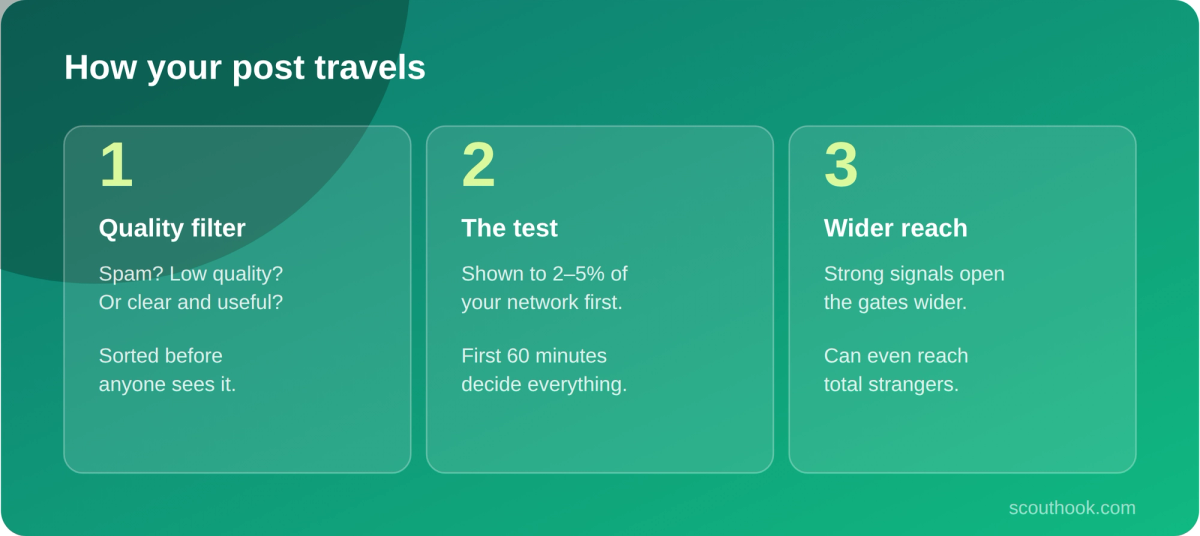
Whatever you post, it moves through the same three gates. Understanding them tells you exactly where posts live or die.
Stage 1: The quality filter
The instant you publish, your post gets sorted into a bucket, spam, low quality, or high quality, before a single human sees it. This is where clarity matters most. When a post is vague or confusing, the system can't categorize it, readers bounce fast, and both of those things quietly cap your reach. Clear, specific, obviously-professional content sails through.
Stage 2: The test audience
Pass the filter and LinkedIn shows your post to a small slice of your network, roughly 2 to 5 percent. Then it watches, closely, for the first 60 minutes or so. This is the golden hour, and it's not about whether people engage but how. Thoughtful comment or a reflex like? Did they read, or scroll past? Strong early signals unlock the next stage. Weak ones, and your post quietly dies right here. Most do.
Stage 3: Wider distribution
Clear the test and the gates open, second and third-degree connections, topic feeds, and here's the genuinely new part: with the March 2026 LLM-based feed, high-relevance posts can now surface for people completely outside your network, based purely on topic alignment. Reach used to stop at your network's edge. Not anymore. A strong post can keep pulling reach for 48 to 72 hours, sometimes longer.
Not all engagement is equal (this is the big one)
If you take one practical thing from this whole piece, take this. LinkedIn weighs engagement types very differently now, and the weights shifted hard. Most people are still chasing the signal that matters least.
Comments are king
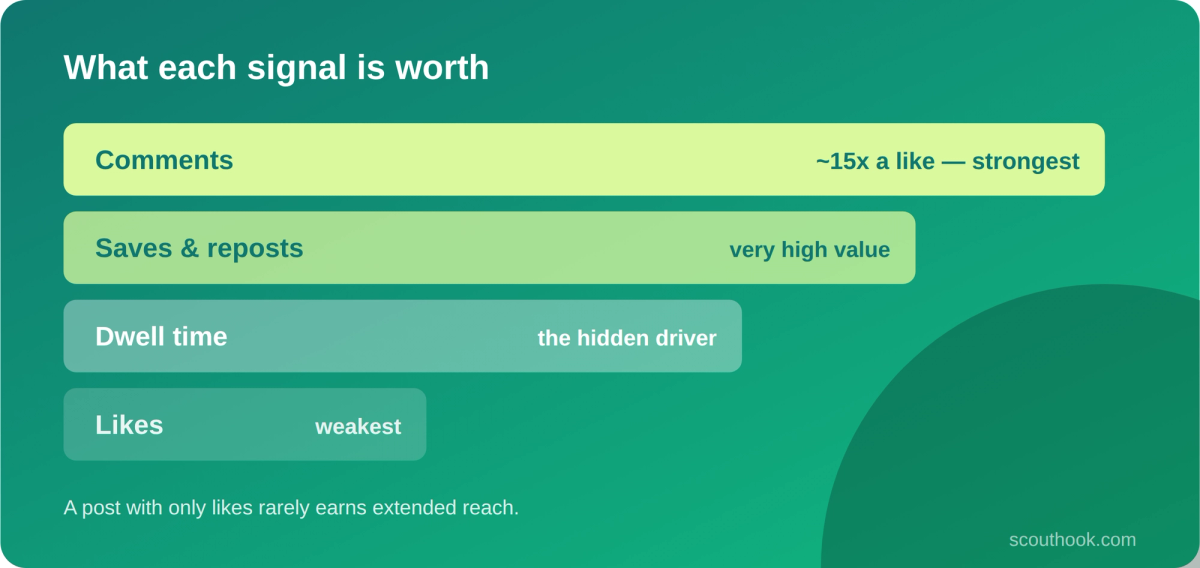
Comments are now the single most powerful organic signal, and the gap has widened a lot. Analysis from 2026 suggests comments carry roughly 15 times more algorithmic weight than a basic like. But not any comment. The system reads whether a reply actually contributes to the topic. "Great post!" registers as noise. A three-sentence reaction that adds a point starts a thread, and threads are gold. So reply to every comment on your posts, fast, and make your replies worth replying to.
Dwell time is the quiet one
This is the signal almost everyone overlooks because it leaves no visible trace. Dwell time, how long someone spends on your content before scrolling, has become a primary quality signal in 2026, and a post someone reads for 45 seconds before liking beats a post that gets 50 quick likes with an average engagement time of 3 seconds. It's why formatting matters so much now. Short paragraphs, line breaks, a hook that earns the "see more" click, all of it buys you seconds, and seconds buy you reach.
Saves are underrated
When someone bookmarks your post to come back to it, that's an extremely strong quality signal and one most creators completely ignore. The move here is to make content worth saving: frameworks, checklists, step-by-step processes, the kind of thing people want to find again. If your post is genuinely referenceable, saves follow, and saves punch way above their weight.
Likes are basically decoration
Reactions confirm someone saw your post. That's it. They've become the weakest meaningful metric, and a post that pulls only likes, no comments, no saves, is unlikely to get pushed any further. Nice for the ego. Almost nothing for the reach.
Your profile is now part of every post
Here's a shift that catches people off guard: your profile isn't just a landing page anymore, it's an active ranking input. 360Brew reads the creator's profile, the headline, About section, and experience, as part of every ranking decision.
The practical takeaway is almost funny in how direct it is. One creator who reverse-engineers the algorithm advises setting your profile up to look like you are a specific job within a specific sector, so the system knows exactly who your content is for. Vague headlines like "Marketing Professional" underperform specific ones like "B2B SaaS Marketing, SEO Specialist." The clearer your profile signals your niche, the more accurately 360Brew delivers your posts to the right people. Your profile and your posts are now one system.
What's being actively punished in 2026
The March 2026 Authenticity Update didn't just tweak things, it took a flamethrower to a whole era of tactics. Here's what's actively suppressed now, so you can audit your own posts.
Engagement bait. "Agree? Comment YES 👇" and its cousins are dead. The system detects these patterns and suppresses them. If your reach cratered this spring, check your recent posts for this first.
External links. Posts with outbound links see roughly 60 percent less reach than identical link-free posts. And the classic "link in first comment" dodge? Also penalized now. Deliver the value natively, drop the link in the comments if you must.
Engagement pods and automation. Coordinated like-and-comment rings and automation tools got aggressively deprioritized. The system is good at spotting inauthentic engagement patterns.
Polls. They can spike reach but tank everything else. One high-follower creator who tested extensively calls them terrible for follower growth and conversion. Fine for occasional audience research, bad as a core strategy.
Hashtag stuffing. Hashtags barely move distribution anymore now that the system reads topic from your actual text. A couple of relevant ones won't hurt, but they're no longer a lever. Stop counting on them.
Templated, robotic-sounding content. The system got sophisticated enough to detect generic corporate-speak, even dressed up with nice graphics. Specific, human, first-person writing wins. Vague and polished loses.
What actually works now
So if the hacks are dead, what's left? Honestly, the stuff that was always supposed to work, just now it's enforced rather than optional.
Pick a lane and stay in it. 360Brew rewards topical consistency hard. Post about one clear thing for 60 to 90 days and the system starts recognizing you as an authority on it, boosting every post. Bounce between topics and you stay invisible. If you must broaden your range, do it gradually over months, not overnight, because creators who abruptly pivoted got, in one memorable phrase, deprioritized out of existence.
Use the formats the algorithm loves. Document carousels, uploaded as PDFs, remain the single highest-performing organic format in 2026, generating 2 to 3 times more dwell time than text-only posts because every swipe is a measurable interaction. One caveat: keep them to eight to ten slides and make them worth finishing, because low completion rates now hurt you. Native video works well too. Plain single images, oddly, now underperform plain text.
Nail the first hour. Since the golden hour decides distribution, post when your audience is actually online, then show up. Reply to early comments within minutes, not hours. That early conversation velocity is what tips the algorithm toward pushing you wider.
Write for dwell time, not for likes. A strong hook in the first two lines, short scannable paragraphs, a clear payoff. Give people a reason to actually read, because reading time is the signal that quietly runs the whole show.
Be consistent, without burning out. The algorithm builds an internal credibility score from your track record, and it takes 60 to 90 days of steady, quality posting before you see real movement. That's a marathon, which is exactly why a sane, sustainable cadence beats a two-week sprint. We dug into the exact numbers in our guide on how often to post on LinkedIn.
The one-sentence version
If all of this collapses into a single idea, it's this: LinkedIn stopped rewarding who shouts loudest and started rewarding who genuinely knows the most. The system now reads meaning, so the winning move isn't a trick, it's picking a topic you actually know, writing about it like a specific human, and giving people something worth reading, saving, and replying to.
That's harder than a hack. It's also a lot more durable, because there's no update coming that punishes being genuinely useful.
Write for the 2026 algorithm, faster
ScoutHook helps you stay on-topic, hook attention in the first two lines, and turn one idea into a week of posts, so consistency stops being the hard part. Try ScoutHook
Frequently asked questions
How does the LinkedIn algorithm work in 2026?
It runs on a unified AI called 360Brew that reads the meaning of your post and profile, then delivers it to people likely to find it useful, even outside your network. Posts pass through a quality filter, a first-hour test audience, then wider reach if early signals are strong.
What's the most important ranking signal?
Comments, by a wide margin, roughly 15x the weight of a like. Dwell time and saves come next. Likes are the weakest meaningful signal.
Do external links hurt reach?
Yes, around 60 percent less reach with an outbound link, and the "link in first comment" workaround is now penalized too. Keep the value native, link in comments.
Which format performs best?
Document (PDF) carousels, averaging about 6.6 percent engagement, because they generate the most dwell time. Keep them under ten slides. Native video is strong; single images now underperform text.