
Last month, you authored a blog post consisting of two thousand words, which consumed a significant portion of your Saturday. The content is genuinely valuable. You subsequently shared the link on LinkedIn accompanied by a brief caption, resulting in fourteen likes and two comments, one of which was from your cousin.
However, that article is not yet fully serving its purpose. It remains idle, and much of its valuable content has not reached the audience that would truly appreciate it. This discussion focuses on how to disseminate that content effectively, whether you are starting with a blog post, a PDF that you once exported and neglected, or simply a URL that you wish to transform into something that captures people's attention.
The key takeaway is this: refrain from posting the link. Instead, extract the specific claims and arguments from the article and convert each into a concise post articulated in a conversational tone. This approach is applicable whether you are working from a blog post, a PDF, or a straightforward URL. A single quality source can typically yield three to six substantial posts, not by duplicating paragraphs, but by identifying the sentences that convey the core message.
Understanding why links are ineffective is crucial
Two main factors hinder your success in this regard, and most individuals are only aware of one.
The first issue is the reach problem. Posts that include a link to an external site experience approximately 60 percent less reach compared to those that do not. LinkedIn prefers to keep users on its platform and subtly diminishes the visibility of any content that directs users away. Regardless of the quality of the article on the other side, the algorithm restricts the number of viewers who can discover it.
The second issue, which is less frequently discussed, is that a link accompanied by a single sentence does not constitute a post. It merely serves as an advertisement for a post. You are essentially requesting someone to leave the platform based on a brief promise encapsulated in eleven words. Very few individuals will accept that exchange, and those who do often abandon the article within four seconds because your caption failed to convey its value.
Therefore, the solution is not to craft a more compelling caption. It is to avoid posting the link altogether, at least not within the main body of the post. Instead, embed the actual value within the post itself.
Shift your mindset from "repurpose" to "extract"
This is where most advice on this topic falls short.
The lazy version of this whole idea is: paste your article into something, ask for ten posts, get ten posts. Technically you now have content. Practically, what you usually get is the same paragraph chopped into ten slightly different summaries, which is a different kind of nothing than a link, but still nothing.
A blog post makes several distinct claims. A stat you found. A framework you built. A mistake you see people make constantly. An opinion you'd defend if someone pushed back on it. Your job isn't to summarize the whole article seven different ways. It's to go find those individual claims and give each one its own moment, its own post, its own room to actually land.
Read back through the piece with a highlighter, mental or literal, and mark every sentence that could stand alone as a complete thought. Not transition sentences. Not the intro paragraph where you're clearing your throat. The actual assertions. Most 1,500 to 2,000 word posts have somewhere between three and six of these hiding in them. That number is your real post count, and it has nothing to do with how long the article was.
The four things worth pulling out
Once you're looking for claims instead of trying to summarize the whole thing, four kinds of material tend to turn into the strongest posts.
The number that surprised you. If a stat made you stop and reread it when you found it, that reaction is the post. Lead with the number, then the one line of context that makes it land.
The thing you disagree with. Every good article has a moment where you're pushing back against the common wisdom on something. Pull that argument out on its own. Disagreement is what gets people replying instead of scrolling past.
The specific mistake. Not "avoid common pitfalls." The actual mistake, with a real example if you have one. "I did this for three months before I noticed" beats "many people struggle with" every single time.
The line you'd underline. Every piece has a sentence or two doing more work than the rest. If you had to tweet one line from the whole article, which one? That's usually a strong post opener on its own.
Rewriting it so it doesn't read like an excerpt
Pulling the claim out is step one. The part people skip is rewriting it so it sounds like something you'd actually say, not a paragraph that's been surgically removed from a longer piece.
Blog writing and LinkedIn writing are different animals, even when they're covering the same idea. An article can take three sentences to set up a point. A LinkedIn post has about two lines before someone decides whether to keep reading, so the setup has to go. Cut the throat-clearing. Cut "in this section we'll explore." Just say the thing.
A useful test: read your extracted post out loud. If it still sounds like something copied from a document, it probably still has some blog-DNA left in it, formal transitions, softened claims, the polite hedging that academic and corporate writing trains into people. LinkedIn rewards the opposite. Say the number. Say the opinion. Say it the way you'd say it to a colleague over coffee, not the way you'd write it in a memo.
What this looks like with a PDF or a slide deck
Same approach, one small difference worth knowing about.
A PDF or a deck is often already halfway atomized for you. Slides are frequently one idea per slide already, which is basically the format you're going for anyway. The gap is usually connective tissue. A slide might say "Q3 churn: down 12%" with nothing else, because in the room, you explained the rest out loud. On LinkedIn, that context has to be written down, because there's no you standing next to the slide to fill it in.
So when you're working from a deck, add back roughly one sentence of the explanation that used to live in your mouth instead of on the page. The core claim from the slide stays. You're just restoring the part that got lost when the presentation stopped being live.
What if you're starting from just a URL
Sometimes you don't have your own article to work from. You read something somewhere else, a report, a news piece, someone else's post, and you want to turn it into your own take rather than just a link with "interesting read" typed above it.
The method barely changes. Open the URL, find the one or two claims in it that actually made you stop and think, and write your own post around your reaction to that claim rather than a summary of the source. The difference is the post isn't about the article anymore. It's about what you think of it, which is a stronger post anyway, since your opinion is the part nobody else can copy.
If the URL is genuinely just a jumping-off point for your own argument, you don't even need to credit it explicitly in the post. If you're drawing directly on someone's specific data or framework, a quick mention of the source in your own words is the right call.
A five-post pull from one real example
Here's what this looks like against an actual piece, so it's not just theory. Say you wrote 1,800 words on why most companies get customer onboarding wrong.
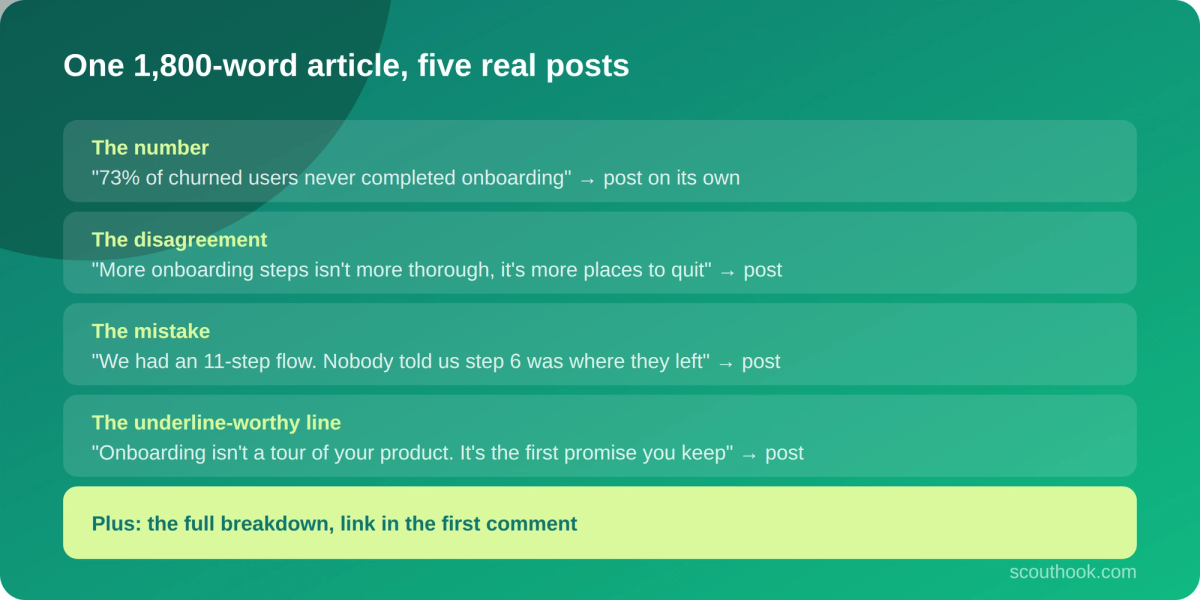
Notice none of those five posts is a summary of the article. Each one is a single idea from inside it, standing on its own, written the way you'd actually say it. That's the whole method. Everything else is just applying it to your own piece.
Spacing it out
Don't post all five the same week, and definitely not the same day. Posting twice in one day actually cuts the reach of the first post, since the algorithm cannibalizes it to go test the second one.
Spread the five posts across three or four weeks, mixed in with whatever else you're already posting. One article, done right, quietly becomes most of a month's content calendar. That's the actual ROI here, not the traffic back to the blog. The blog traffic is a bonus. The month of posts is the point.
If you want the mechanics of pacing beyond this one article, we mapped out the full timing data in our piece on how often to post on LinkedIn.
Where this gets slow if you're doing it by hand
Honest moment. Reading back through a 2,000-word article with a highlighter, pulling out the real claims, and rewriting each one so it doesn't sound extracted takes real time. Twenty minutes if you're fast, closer to an hour if you're being careful about the rewrite. Most people do this once, feel the drag, and quietly go back to just posting the link.
This is the exact thing ScoutHook is built to shorten without cutting the quality corner. Drop in a blog post, a PDF, or a link, and it pulls out the distinct claims the way described above, then asks you a couple of questions to make sure each post lands in your actual voice instead of reading like a lifted paragraph. You're still the one deciding what's worth saying. It just handles the part where you're hunting through your own writing for the sentences that matter.
Turn what you already wrote into what you haven't posted yet. Drop a blog post, PDF, or link into ScoutHook and it finds the claims worth their own post, then keeps the writing in your voice. Try ScoutHook → https://www.scouthook.com
The one habit worth keeping
If you remember nothing else from this, remember the highlighter test. Before you post anything pulled from a longer piece, ask if it could stand alone as a complete thought without the paragraph around it. If yes, it's a post. If it only makes sense next to three other sentences, it's still buried in the article, and pulling it out early just means posting something half-formed.
You already did the hard part when you wrote the original piece. This is just the part where it stops sitting on one page and starts actually working for you.
Frequently asked questions
Can I just copy and paste my blog post onto LinkedIn?
You can, but it usually underperforms since LinkedIn favors native writing over pasted long-form text. Pull the individual claims out and rewrite each as its own post instead of posting the article as one block.
Should I link to my blog post in the post itself?
Not in the body. Outbound links cost roughly 60 percent of your reach. Put the value directly in the post, and drop the link in the first comment if you want to send people to the full piece.
How many LinkedIn posts can I get from one blog post?
Usually three to six, depending on how many separate claims the piece actually makes. A 2,000-word article with one real point might only give you one strong post. One packed with distinct findings could give you six.
Does this work for PDFs and slide decks too?
Yes, almost the same process. Decks are often already broken into single ideas, so the main extra step is writing back in the spoken context that used to live off the page.